

Working with Lime
It is believed that lime mortar was first used approximately 6,500 years ago. Testaments to its durability are still visible today such as the ancient Egyptians using it in the construction of the Pyramids approximately 4,000 years ago. Lime has stood the test of time.
Before cement became common, lime was the main material used in construction around the world. It was used in mortars, plasters, paints and even waterproofing. The reason for its versatility is that Lime is Live meaning it is in essence, a living and breathing material.
Lime mortar is associated with building conservation and sustainability.
Wherever the term "lime mortar" is used the emphasis is on the traditional and environmentally friendly aspects of the material.
The use of modern materials such as cement brought about the decline of lime mortars but modern cements have since been found to cause damage to historic buildings over time.
Building Conservation
Legislation stipulates the use of lime mortar for listed buildings and buildings in conservation areas
Historic Properties
Many heritage property owners require repairs to be carried out using original material and preserving period details
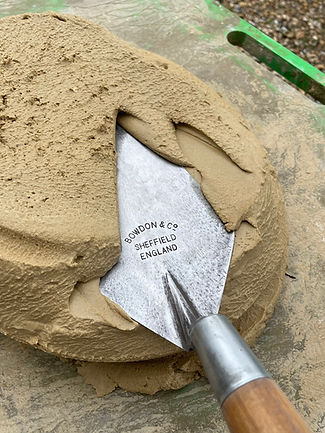
Prevent Damp
Lime mortar is breathable, it can prevent and alleviate damp problems, particular in old buildings with solid walls
Structural Movement
Lime mortar is relatively flexible, allowing for a greater degree of movement
Environmental
The carbon footprint of lime is much lower than cement which is responsible for a high amount of global CO² emissions
Adhesion Properties
Gentle binding properties with good stickiness giving good adhesion to other surfaces

Understanding the Lime Cycle
The natural process through which lime transforms and regenerates itself
Step 1: Limestone to Quicklime (Calcination)
Limestone, a rock rich in calcium carbonate (CaCO₃) — formed from the remains of marine shells and corals over millions of years. When limestone is heated in a kiln at around 900–1,000°C, it undergoes calcination, releasing carbon dioxide (CO₂) and turning into quicklime (calcium oxide, CaO).
CaCO3 (limestone) → heat CaO (quicklime) + CO2 (gas)
From stone to a reactive, high-energy material. Quicklime is extremely caustic and must be handled with care.
Step 2: Quicklime to Slaked Lime (Hydration)
When quicklime comes in contact with water, there is a vigorous reaction, releasing heat and expanding. This process is called 'slaking', and the result is slaked lime powder or lime putty (calcium hydroxide, Ca(OH)₂).
CaO (quicklime) + H2O (water) → Ca(OH)2 (slaked lime)
The quality of the slaking process determines everything the end product and therefore an important part of the cycle. A good slake which is slow and even will produce creamy, plastic lime putty that can last for years if kept submerged in water.
Step 3: Slaked Lime to Carbonated Lime (Setting and Hardening)
When applying lime mortar or lime plaster, it doesn’t “set” in the same way of cement. It hardens by absorbing carbon dioxide (CO₂) from the atmosphere, this is a slow process called carbonation.
Ca(OH)2 (slaked lime) + CO2 (air) → CaCO3 (limestone) + H2O
During this process, lime returns to its original stone form — calcium carbonate (CaCO₃). It literally turns back into stone, one molecule at a time. Which is why lime is referred to as a living material, because it breathes, reacts and regenerates.
This natural carbonation makes lime:
-
Breathable – it allows moisture to escape, reducing dampness and mold.
-
Flexible – it moves with the building without cracking.
-
Self-healing – small cracks close as carbonation continues.
-
Low-energy – it reabsorbs much of the CO₂ released during burning.
Step 4: Completing the Cycle — Stone Again
When carbonation is complete, lime becomes limestone once again. The cycle has come full circle:
Limestone → Quicklime → Slaked Lime → Carbonated Lime → Limestone
This closed-loop process is nature’s perfect recycling system. If lime-based waste is left to weather naturally, it can rejoin the earth harmlessly. But when mixed with cement, polymers, or synthetic paints, this cycle breaks — turning a regenerative material into landfill waste.
Researched from: shahhempinnoventures.com
Slaking Hot Lime

Wall Repair
The wall is over 125 years old, and the majority of it is still in very good condition, it was just the top that had failed due to cement repairs over the years.

Garden Folly
Using reclaimed bricks to build a garden folly. By using lime mortar rather than cement, you can ensure an authentic finish and a highly durable construction.

Contemporary
Lime has been used for thousands of years, as evidenced by use in the construction of the Egyptian pyramids, showcasing its longevity. In contemporary garden design, lime adds a stunning touch, creating a timeless, traditional look.